Recall the relations of facticity, figurality, and fetishism that have preoccupied our course. Think of the different relations posited between poiesis and theoria (think how differently Barthes and Haraway talk about Myth, for example). Think of the turns of critical theory, from the post-philosophical threshold figures of Marx, Nietzsche, and Freud, to the postwar turn to biopolitics in Arendt, Fanon, and Foucault, to the later turn we discern in Haraway, Butler, Gilroy, Latour, and Spivak. Think about the problems and promises of the crisis of digital finance and vacuous "open" networks and environmental catastrophe: what planetary futurity is emerging out of the ruins of white racist patriarchal global extractive industrial corporate-militarism?
The following is from "Planetarity," Chapter Three of Death of a Discipline by Gayatri Chakravorty Spivak, published in 2003 by the Columbia University Press and based on the Wellek Library Lectures in Critical Theory she delivered in May 2000. The following excerpts amount to just a few pages from a much longer text and are divided (by me) into numbered theses -- most of them shorn of the context of close textual readings that give them their specific vitality -- but each one of which comments in this form on key themes from our course.
One
The meaning of the figure is undecidable, and yet we must attempt to dis-figure it, read the logic of the metaphor. We know that the figure can and will be literalized in yet other ways. All around us is the clamor for the rational destruction of the figure, the demand for not clarity but immediate comprehensibility by the ideological average. This destroys the force of literature as a cultural good… [T]o learn to read is to learn to dis-figure the undecidable figure into a responsible literality, again and again. It is my belief that initiation into cultural explanation is… a training in reading.
Two
I propose the planet to overwrite the globe. Globalization is the imposition of the same system of exchange everywhere. In the gridwork of electronic capital, we achieve that abstract ball covered in latitudes and longitudes, cut by virtual lines, once the equator and the tropics and so on, now drawn by the requirements of Geographical Information Systems. To talk planet-talk by way of unexamined environmentalism, referring to an undivided "natural" space rather than a differentiated political space, can work in the interest of this globalization… The globe is on our computers. No one lives there. It allows us to think we can aim to control it. The planet is in the species of alterity, belonging to another… and yet we inhabit it, on loan…. When I invoke the planet I think of the effort required to figure the (im)possibility of this undrived intuition.
Three
To be human is to be intended toward the other. W provide for ourselves transcendental figurations of… this animating gift: mother, nation, god, nature. These are names of alterity, some more radical than others. Planet-thought opens up to embrace an inexhaustible taxonomy of such names… If we imagine ourselves as… planetary creatures rather than global entities, alterity remains underived from us; it is not our dialectical negation, it contains us as much as it flings us away… We must persistently educate ourselves into this peculiar mindset.
Four
One will have to look out for what Raymond Williams calls the preemergent around the corner, suppressed by a specifically metropolitan moment that emphasizes the uneven and asymmetrical global digital divide. The "preemergent" leads us toward a "structure of feeling." … But thinking of institutional attitudes to be fostered by pedagogy, we do not need to tap those modes, we need only remember them. The altered attitudes toward language learning, areas versus nation-states, figure versus rational expectations… can no doubt be plotted as a "structure of feeling," if that is the language we prefer. The scenario that I am constructing would suggest that the dominant figuring of "prehistory" as cyberpresent or science fiction adventure would interfere with the emergence of the figuration of an undecidable planetary alterity.
Five
The country… is not simply the prenational as opposed to the national. It is also the… mass of the national, to which the blood rushes first and that becomes continuous with the exchange of the Earth. The Earth is the paranational image that can substitute for international and can perhaps provide, today, a displaced site for the imagination of planetarity. The choice of the blood rushing back as the first move, the description of the rural as a specifically national mass, and the inclusion of the trade-related word "redistribution" … seeks to undo the contradiction between the national and the rural.
Six
Just as socialism at its best would persistently and repeatedly wrench capital away frm capitalism, so must the new Comparative Literature persistently and repeatedly undermine and undo the definitive tendency of the dominant to appropriate the emergent… Training in such persistent and repetitive gestures comes, necessarily, in the classroom… This is not an easy "positional skepticism of postmodernist literary and cultural studies," but something to worked through in the interest of yoking the humanities, however distantly, with however few guarantees, to a just world… If we want to compete with the hard "science"(s) and the social sciences at their hardest as "human science," we have already lost, as one loses institutional competition. In the arena of humanities as the uncoercive rearrangement of desire, he who wins loses.
Seven
In this era of global capital triumphant, to keep responsibility alive in the reading and teaching of the textual is at first sight impractical. It is, however, the right of the textual to be so responsible, responsive, answerable. The "planet" is, here, as perhaps always, a catachresis for inscribing collective responsibility as right. Its alterity, determining experience, is mysterious and discontinuous -- an experience of the impossible. It is such collectivities that must be opened up with the question "How many are we?" when cultural origin is detranscendentalized into fiction -- the toughest task in the diaspora.
Thursday, August 07, 2014


Wednesday, August 06, 2014
Tuesday, July 29, 2014
Bring Your Reading Journals To Class
...because I expect you to take notes and transcribe quotes as we screen the film tomorrow. I will be pausing the film throughout -- annoying, I know! -- and we will be discussing it after the screening is over. Tomorrow's class is not missable just 'cause it's movie nite, trust. Btw, all the links for readings this week should now be live -- if you checked earlier and missed one, they she all be online now. See you soon, feel free to bring popcorn.
Saturday, July 26, 2014
Food for Thought (and Comments)
In a summer intensive we are especially ruthlessly confined by available time to a focus on assigned texts and topics. And one of the costs of that confinement is that we really have little occasion to think about the ways in which the ideas we are reading about might illuminate daily events in our lives and in the public in the moment.
This is disappointing because even though I can't ever know in advance as an instructor just how such discussions will go they are often incredibly clarifying of theoretical issues for the same reasons -- personal stakes are raised because people living with quandaries in the moment often haven't determined for themselves exactly what they feel about such events, even as the urgency and feelings in the moment are all the stronger for the upset occasioned by the events in the first place.
Since folks are looking for an opportunity to provide comments this weekend, I've been posting lots of extra material to give you a richer field of texts, YouTube clips, and so on to react to and talk about in comments. Let me provide another one as well. Feel free to add your own as well.
How might our understanding of the recent spate of botched executions in Arizona and elsewhere be clarified or complicated by the discussion of torture and human experimentation and "benign" incarceration in Foucault's Discipline and Punish? Discuss!
This is disappointing because even though I can't ever know in advance as an instructor just how such discussions will go they are often incredibly clarifying of theoretical issues for the same reasons -- personal stakes are raised because people living with quandaries in the moment often haven't determined for themselves exactly what they feel about such events, even as the urgency and feelings in the moment are all the stronger for the upset occasioned by the events in the first place.
Since folks are looking for an opportunity to provide comments this weekend, I've been posting lots of extra material to give you a richer field of texts, YouTube clips, and so on to react to and talk about in comments. Let me provide another one as well. Feel free to add your own as well.
How might our understanding of the recent spate of botched executions in Arizona and elsewhere be clarified or complicated by the discussion of torture and human experimentation and "benign" incarceration in Foucault's Discipline and Punish? Discuss!
Friday, July 25, 2014
Clarifying Mid-Term Business
I've gotten some questions via e-mail, so I want to be as clear as possible for everybody. You have until 11:59:59 Sunday night, July 27th to post your first precis (or e-mail it to me to post for you) and have made at least half a dozen online comments. The precis is roughly a two page document, so you probably shouldn't think of it as a "paper" -- a fully fledged paper, even a short one, is a more comprehensive and systematic elaboration of a case or accounting of an object than the precis. Pick a passage, or a handful of details, say what the argument is in that passage or in those details, don't retreat into lame generalizations. The precis should raise a question, provide the point of departure for a deeper conversation -- but it isn't long enough to answer the question decisively or have the whole conversation. I hope this helps.
Docile Bodies
Here is another excerpt from Discipline and Punish for those of you who want to dig deeper.
Freud Fetishism Link Should Now Be Live
Thanks for letting me know about the problem in advance, and do let me know if more problems crop up.
Wednesday, July 16, 2014
from The Gay Science
124 In the Horizon of the Infinite.
We have left the land and have gone aboard ship! We have broken down the bridge behind us - nay, more, the land behind us! Well, little ship! look out! Beside thee is the ocean; it is true it does not always roar, and sometimes it spreads out like silk and gold and a gentle reverie. But times will come when thou wilt feel that it is infinite, and that there is nothing more frightful than infinity. Oh, the poor bird that felt itself free, and now strikes against the walls of this cage! Alas, if homesickness for the land should attack thee, as if there had been more freedom there - and there is no "land" any longer!
125 The Madman.
Have you ever heard of the madman who on a bright morning lighted a lantern and ran to the market-place calling out unceasingly: "I seek God! I seek God!" As there were many people standing about who did not believe in God, he caused a great deal of amusement. Why? is he lost? said one. Has he strayed away like a child? said another. Or does he keep himself hidden? Is he afraid of us? Has he taken a sea voyage? Has he emigrated? - the people cried out laughingly, all in a hubbub. The insane man jumped into their midst and transfixed them with his glances. "Where is God gone?" he called out. "I mean to tell you! We have killed him, you and I! We are all his murderers! But how have we done it? How were we able to drink up the sea? Who gave us the sponge to wipe away the whole horizon? What did we do when we loosened this earth from its sun? Whither does it now move? Whither do we move? Away from all suns? Do we not dash on unceasingly? Backwards, sideways, forwards, in all directions? Is there still an above and below? Do we not stray, as through infinite nothingness? Does not empty space breathe upon us? Has it not become colder? Does not night come on continually, darker and darker? Shall we not have to light lanterns in the morning? Do we not hear the noise of the grave-diggers who are burying God? Do we not smell the divine putrefaction? - for even Gods putrefy! God is dead! God remains dead! And we have killed him! How shall we console ourselves, the most murderous of all murderers? The holiest and the mightiest that the world has hitherto possessed, has bled to death under our knife - who will wipe the blood from us? With what water could we cleanse ourselves? What lustrums, what sacred games shall we have to devise? Is not the magnitude of this deed too great for us? Shall we not ourselves have to become Gods, merely to seem worthy of it? There never was a greater event - and on account of it, all who are born after us belong to a higher history than any history hitherto!" Here the madman was silent and looked again at his hearers; they also were silent and looked at him in surprise. At last he threw his lantern on the ground, so that it broke in pieces and was extinguished. "I come too early," e then said. "I am not yet at the right time. This prodigious event is still on its way, and is traveling - it has not yet reached men's ears. Lightning and thunder need time, the light of the stars needs time, deeds need time, even after they are done, to be seen and heard. This deed is as yet further from them than the furthest star - and yet they have done it themselves!" It is further stated that the madman made his way into different churches on the same day, and there intoned his Requiem aeternam deo. When led out and called to account, he always gave the reply: "What are these churches now, if they are not the tombs and monuments of God?"
143. The greatest advantage of polytheism
For an individual to posit his own ideal and to derive from it his own law, joys, and rights—that may well have been considered hitherto as the most outrageous human aberration and as idolatry itself. The few who dared as much always felt the need to apologize to themselves, usually by saying: "It wasn't I! Not I! But a god through me!" The wonderful art and gift of creating gods — polytheism — was the medium through which this impulse could discharge, purifiy, perfect, and ennoble itself; for originally it was a very undistinguished impulse, related to stubbornness, disobedience and envy. Hostility against this impulse to have an ideal of one's own was formerly the central law of all morality. There was only one norm, man; and every people thought that it possessed this one ultimate norm. But above and outside, in some distant overworld, one was permitted to behold a plurality of norms; one god was not considered a denial of another god, nor blasphemy against him. It was here that the luxury of individuals was first permitted; it was here that one first honored the rights of individuals. The invention of gods, heroes, and overmen of all kinds, as well as near-men and undermen, of dwarfs, fairies, centaurs, satyrs, demons, and devils was the inestimable preliminary exercise for the justification of the egoism and sovereignty of the individual: the freedom that one conceded to a god in his relation to other gods—one eventually also granted to oneself in relation to laws, customs, and neighbors.
Monotheism, on the other hand, this rigid consequence of the doctrine of one normal human type— the faith in one normal human god beside whom there are only pseudo-gods—was perhaps the greatest danger that has yet confronted humanity. It threatened us with the premature stagnation that, as far as we can see, most other species have long reached; for all of them believe in one normal type and ideal for their species, and they have translated the morality of mores definitively into their own flesh and blood. In polytheism the free-spiriting and many-spiriting of man obtained its first preliminary form—the strength to create for ourselves our own new eyes—and ever again new eyes that are even more are own: hence man alone among all the animals has no eternal horizons and perspectives.
290 One Thing is Needful.
To "give style" to one's character-that is a grand and a rare art! He who surveys all that his nature presents in its strength and in its weakness, and then fashions it into an ingenious plan, until everything appears artistic and rational, and even the weaknesses enchant the eye-exercises that admirable art. Here there has been a great amount of second nature added, there a portion of first nature has been taken away-in both cases with long exercise and daily labor at the task. Here the ugly, which does not permit of being taken away, has been concealed, there it has been re-interpreted into the sublime. Much of the vague, which refuses to take form, has been reserved and utilized for the perspectives-it is meant to give a hint of the remote and immeasurable. In the end, I when the work has been completed, it is revealed how it was the constraint of the same taste that organized and fashioned it in whole and in part: whether the taste was good or bad is of less importance than one thinks-it is sufficient that it was a taste!It will be the strong imperious I natures which experience their most refined joy in such constraint, in such confinement and perfection under their own law; the passion of their I violent volition lessens at the sight of all disciplined nature, all conquered and ministering nature: even when they have pa laces to build and gardens to lay out, it is not to their taste to allow nature to be free. It is the reverse with weak characters who have not power over themselves, and hate the restriction of style: they feel that if this repugnant constraint were laid upon them, they would necessarily become vulgarized under it: they become slaves as soon as they serve, they hate service. Such intellects-they may be intellects of the first rank-are always concerned with fashioning and interpreting themselves and their surroundings as free nature-wild, arbitrary, fantastic, confused and surprising: and it is well for them to do so, because only in this manner can they please themselves! For one thing is needful: namely, that man should attain to satisfaction with himself-be it but through this or that fable and artifice: it is only then that man's aspect is at all endurable! He who is dissatisfied with himself is ever ready to avenge himself on that account: we others will be his victims, if only in having always to endure his ugly aspect. For the aspect of the ugly makes one mean and sad.
341 The Greatest Burden.
What if a demon crept after thee into thy loneliest loneliness some day or night, and said to thee: "This life, as thou livest it at present, and hast lived it, thou must live it once more, and also innumerable times; and there will be nothing new in it, but every pain and every joy and every thought and every sigh, and all the unspeakably small and great in thy life must come to thee again, and all in the same series and sequence-and similarly this spider and this moonlight among the trees, and similarly this moment, and I myself. The eternal sand-glass of existence will ever be turned once more, and thou with it, thou speck of dust!"- Wouldst thou not throw thyself down and gnash thy teeth, and curse the demon that so spake? Or hast thou once experienced a tremendous moment in which thou wouldst answer him: "Thou art a God, and never did I hear anything so divine! "If that thought acquired power over thee as thou art, it would transform thee, and perhaps crush thee; the question with regard to all and everything: "Dost thou want this once more, and also for innumerable times?" would lie as the heaviest burden upon thy activity! Or, how wouldst thou have to become favorably inclined to thyself and to life, so as to long for nothing more ardently than for this last eternal sanctioning and sealing?
We have left the land and have gone aboard ship! We have broken down the bridge behind us - nay, more, the land behind us! Well, little ship! look out! Beside thee is the ocean; it is true it does not always roar, and sometimes it spreads out like silk and gold and a gentle reverie. But times will come when thou wilt feel that it is infinite, and that there is nothing more frightful than infinity. Oh, the poor bird that felt itself free, and now strikes against the walls of this cage! Alas, if homesickness for the land should attack thee, as if there had been more freedom there - and there is no "land" any longer!
125 The Madman.
Have you ever heard of the madman who on a bright morning lighted a lantern and ran to the market-place calling out unceasingly: "I seek God! I seek God!" As there were many people standing about who did not believe in God, he caused a great deal of amusement. Why? is he lost? said one. Has he strayed away like a child? said another. Or does he keep himself hidden? Is he afraid of us? Has he taken a sea voyage? Has he emigrated? - the people cried out laughingly, all in a hubbub. The insane man jumped into their midst and transfixed them with his glances. "Where is God gone?" he called out. "I mean to tell you! We have killed him, you and I! We are all his murderers! But how have we done it? How were we able to drink up the sea? Who gave us the sponge to wipe away the whole horizon? What did we do when we loosened this earth from its sun? Whither does it now move? Whither do we move? Away from all suns? Do we not dash on unceasingly? Backwards, sideways, forwards, in all directions? Is there still an above and below? Do we not stray, as through infinite nothingness? Does not empty space breathe upon us? Has it not become colder? Does not night come on continually, darker and darker? Shall we not have to light lanterns in the morning? Do we not hear the noise of the grave-diggers who are burying God? Do we not smell the divine putrefaction? - for even Gods putrefy! God is dead! God remains dead! And we have killed him! How shall we console ourselves, the most murderous of all murderers? The holiest and the mightiest that the world has hitherto possessed, has bled to death under our knife - who will wipe the blood from us? With what water could we cleanse ourselves? What lustrums, what sacred games shall we have to devise? Is not the magnitude of this deed too great for us? Shall we not ourselves have to become Gods, merely to seem worthy of it? There never was a greater event - and on account of it, all who are born after us belong to a higher history than any history hitherto!" Here the madman was silent and looked again at his hearers; they also were silent and looked at him in surprise. At last he threw his lantern on the ground, so that it broke in pieces and was extinguished. "I come too early," e then said. "I am not yet at the right time. This prodigious event is still on its way, and is traveling - it has not yet reached men's ears. Lightning and thunder need time, the light of the stars needs time, deeds need time, even after they are done, to be seen and heard. This deed is as yet further from them than the furthest star - and yet they have done it themselves!" It is further stated that the madman made his way into different churches on the same day, and there intoned his Requiem aeternam deo. When led out and called to account, he always gave the reply: "What are these churches now, if they are not the tombs and monuments of God?"
143. The greatest advantage of polytheism
For an individual to posit his own ideal and to derive from it his own law, joys, and rights—that may well have been considered hitherto as the most outrageous human aberration and as idolatry itself. The few who dared as much always felt the need to apologize to themselves, usually by saying: "It wasn't I! Not I! But a god through me!" The wonderful art and gift of creating gods — polytheism — was the medium through which this impulse could discharge, purifiy, perfect, and ennoble itself; for originally it was a very undistinguished impulse, related to stubbornness, disobedience and envy. Hostility against this impulse to have an ideal of one's own was formerly the central law of all morality. There was only one norm, man; and every people thought that it possessed this one ultimate norm. But above and outside, in some distant overworld, one was permitted to behold a plurality of norms; one god was not considered a denial of another god, nor blasphemy against him. It was here that the luxury of individuals was first permitted; it was here that one first honored the rights of individuals. The invention of gods, heroes, and overmen of all kinds, as well as near-men and undermen, of dwarfs, fairies, centaurs, satyrs, demons, and devils was the inestimable preliminary exercise for the justification of the egoism and sovereignty of the individual: the freedom that one conceded to a god in his relation to other gods—one eventually also granted to oneself in relation to laws, customs, and neighbors.
Monotheism, on the other hand, this rigid consequence of the doctrine of one normal human type— the faith in one normal human god beside whom there are only pseudo-gods—was perhaps the greatest danger that has yet confronted humanity. It threatened us with the premature stagnation that, as far as we can see, most other species have long reached; for all of them believe in one normal type and ideal for their species, and they have translated the morality of mores definitively into their own flesh and blood. In polytheism the free-spiriting and many-spiriting of man obtained its first preliminary form—the strength to create for ourselves our own new eyes—and ever again new eyes that are even more are own: hence man alone among all the animals has no eternal horizons and perspectives.
290 One Thing is Needful.
To "give style" to one's character-that is a grand and a rare art! He who surveys all that his nature presents in its strength and in its weakness, and then fashions it into an ingenious plan, until everything appears artistic and rational, and even the weaknesses enchant the eye-exercises that admirable art. Here there has been a great amount of second nature added, there a portion of first nature has been taken away-in both cases with long exercise and daily labor at the task. Here the ugly, which does not permit of being taken away, has been concealed, there it has been re-interpreted into the sublime. Much of the vague, which refuses to take form, has been reserved and utilized for the perspectives-it is meant to give a hint of the remote and immeasurable. In the end, I when the work has been completed, it is revealed how it was the constraint of the same taste that organized and fashioned it in whole and in part: whether the taste was good or bad is of less importance than one thinks-it is sufficient that it was a taste!It will be the strong imperious I natures which experience their most refined joy in such constraint, in such confinement and perfection under their own law; the passion of their I violent volition lessens at the sight of all disciplined nature, all conquered and ministering nature: even when they have pa laces to build and gardens to lay out, it is not to their taste to allow nature to be free. It is the reverse with weak characters who have not power over themselves, and hate the restriction of style: they feel that if this repugnant constraint were laid upon them, they would necessarily become vulgarized under it: they become slaves as soon as they serve, they hate service. Such intellects-they may be intellects of the first rank-are always concerned with fashioning and interpreting themselves and their surroundings as free nature-wild, arbitrary, fantastic, confused and surprising: and it is well for them to do so, because only in this manner can they please themselves! For one thing is needful: namely, that man should attain to satisfaction with himself-be it but through this or that fable and artifice: it is only then that man's aspect is at all endurable! He who is dissatisfied with himself is ever ready to avenge himself on that account: we others will be his victims, if only in having always to endure his ugly aspect. For the aspect of the ugly makes one mean and sad.
341 The Greatest Burden.
What if a demon crept after thee into thy loneliest loneliness some day or night, and said to thee: "This life, as thou livest it at present, and hast lived it, thou must live it once more, and also innumerable times; and there will be nothing new in it, but every pain and every joy and every thought and every sigh, and all the unspeakably small and great in thy life must come to thee again, and all in the same series and sequence-and similarly this spider and this moonlight among the trees, and similarly this moment, and I myself. The eternal sand-glass of existence will ever be turned once more, and thou with it, thou speck of dust!"- Wouldst thou not throw thyself down and gnash thy teeth, and curse the demon that so spake? Or hast thou once experienced a tremendous moment in which thou wouldst answer him: "Thou art a God, and never did I hear anything so divine! "If that thought acquired power over thee as thou art, it would transform thee, and perhaps crush thee; the question with regard to all and everything: "Dost thou want this once more, and also for innumerable times?" would lie as the heaviest burden upon thy activity! Or, how wouldst thou have to become favorably inclined to thyself and to life, so as to long for nothing more ardently than for this last eternal sanctioning and sealing?
"There Is No Royal Road to Science"
Karl Marx
1872 PREFACE TO THE FRENCH EDITION of Capital Volume One
To the citizen Maurice Lachâtre
Dear Citizen,
I applaud your idea of publishing the translation of “Das Kapital” as a serial. In this form the book will be more accessible to the working class, a consideration which to me outweighs everything else.
That is the good side of your suggestion, but here is the reverse of the medal: the method of analysis which I have employed, and which had not previously been applied to economic subjects, makes the reading of the first chapters rather arduous, and it is to be feared that the French public, always impatient to come to a conclusion, eager to know the connexion between general principles and the immediate questions that have aroused their passions, may be disheartened because they will be unable to move on at once.
That is a disadvantage I am powerless to overcome, unless it be by forewarning and forearming those readers who zealously seek the truth. There is no royal road to science, and only those who do not dread the fatiguing climb of its steep paths have a chance of gaining its luminous summits.
Believe me, dear citizen, Your devoted,
Karl Marx
London, March 18, 1872
1872 PREFACE TO THE FRENCH EDITION of Capital Volume One
To the citizen Maurice Lachâtre
Dear Citizen,
I applaud your idea of publishing the translation of “Das Kapital” as a serial. In this form the book will be more accessible to the working class, a consideration which to me outweighs everything else.
That is the good side of your suggestion, but here is the reverse of the medal: the method of analysis which I have employed, and which had not previously been applied to economic subjects, makes the reading of the first chapters rather arduous, and it is to be feared that the French public, always impatient to come to a conclusion, eager to know the connexion between general principles and the immediate questions that have aroused their passions, may be disheartened because they will be unable to move on at once.
That is a disadvantage I am powerless to overcome, unless it be by forewarning and forearming those readers who zealously seek the truth. There is no royal road to science, and only those who do not dread the fatiguing climb of its steep paths have a chance of gaining its luminous summits.
Believe me, dear citizen, Your devoted,
Karl Marx
London, March 18, 1872
Marx As the "Darwin of History"
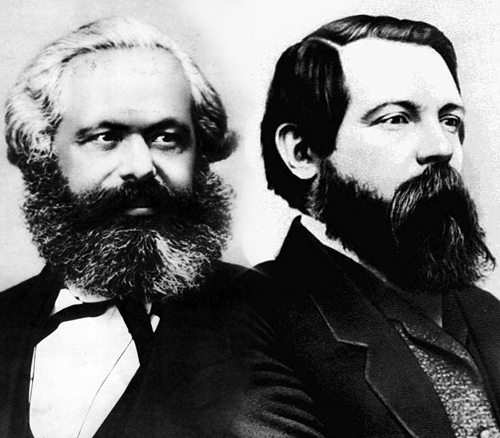
In his 1888 Preface to The Communist Manifesto, Frederick Engels attributes to Marx a “proposition which, in my opinion, is destined to do for history what Darwin’s theory has done for biology[.]” This proposition is as follows:
[I]n every historical epoch, the prevailing mode of economic production and exchange, and the social organization necessarily following from it, form the basis upon which is built up, and from which alone can be explained, the political and intellectual history of that epoch; that consequently the whole history of mankind (since the dissolution of primitive tribal society, holding land in common ownership) has been a history of class struggles, contests between exploiters and exploited, ruling and oppressed classes; that the history of these class struggles forms a series of evolutions in which, nowadays, a stage has been reached where the exploited and oppressed class -– the proletariat –- cannot attain its emancipation from the sway of the exploiting and ruling class –- the bourgeoisie -– without, at the same time, and once and for all, emancipating society at large from all exploitation, oppression, class distinctions and class struggles.
Saturday, July 05, 2014
Our Syllabus
Rhetoric 20:
The Rhetoric of Interpretation:
Who Holds the Keys?
Instructor: Dale Carrico, dcarrico@sfai.edu, ndaleca@gmail.com
Course Blog: http://interpretatio.blogspot.com
Session D, July 7-August 14, TWR, 4-6.30pm, 160 Dwinelle
Attendance/Participation/In-Class Work, 10%; Reading Notebook, 25%; Two Precises, 25%; Twelve+ Comments, 10%; Final Paper, 30%. (Rough Basis for Final Grade, subject to contingencies)
Course Description:
To survey contemporary critical theory is to ask the question, "Who Holds the Keys?" Who are the ones who know how to decipher inscrutable texts, expose longstanding deceptions, illuminate complex social formations, unlock intractable histories? But when we ask just what it is to know these things, and how we know them, and how we know who knows them, we come to realize that our initial question contains within it troubling answers to other sorts of questions, questions about what we think it means to be a "who" and not a "what" in the first place. “Interpretation” derives from the Latin interpretatio, a term freighted with the sense not only of explication and explanation, but also translation. What are the vocabularies and conventions that govern intelligible acts of interpretation, translation, argumentation? What are the conventions through which we constitute the proper objects of interpretation? Who are the subjects empowered to offer up interpretations that compel our attention and change our convictions? Who holds these translation keys?
We will discover that for many of our conversational partners in these investigations, our questions will turn out to turn, astonishingly enough, on various construals of the phenomenon of the fetish. We will discover early that theories of the fetish define the turn of the three threshold figures of critical theory from philosophy to post-philosophical discourse: Marx, Freud, Nietzsche (commodity, sexuality, ressentimentality). Fetishism recurs deliriously thereafter in contemporary critical accounts, feminist, queer, anti-racist, post-colonial, technoscientific, and we will survey many of these. Fetishism may be indispensable to the constitution of the social, the adjudications of the cultural and subcultural, and to representational practices both artistic and political. Is the devotion of the critical to the separation of facts from fancies itself fetishistic? Is fetishism a kind of figurative language, an anti-figurative mode, or a perverse kind of literalization? What are we to make of the way distinctions between fetishism, figuration, and fact can themselves always be drawn fetishistically, figuratively, and factually? All of the readings will be available either online or in a course reader. Where we end up together will, of course, be very much a matter open to interpretation.
Provisional Schedule of Meetings
Week One
July 9 -- Introductions
July 10 -- Bernard le Bovier de Fontenelle, Digression on the Ancients and the Moderns;
Oscar Wilde, The Soul of Man Under Socialism; Preface to The Picture of Dorian Gray; Phrases and Philosophies for the Instruction of the Young; Wilde on Trial
July 11 -- Nietzsche, On Truth and the Lie in an Extramoral Sense; and a few selections from The Gay Science;
Ecce Homo: Preface -- Why I Am So Wise -- Why I Am So Clever -- Why I Am a Destiny (or Fatality)
Week Two
July 16 -– Marx and Engles, Theses on Feuerbach
Marx on Idealism and Materialism
Marx on The Fetishism of Commodities and the Secret Thereof from Capital
July 17 -- Walter Benjamin, Art in the Age of Mechanical Reproducibility and On Photography
Adorno and Horkheimer, The Culture Industry
Adorno, The Culture Industry Reconsidered
July 18 -- Roland Barthes, Mythologies
Daniel Harris, The Futuristic
Week Three
July 23 -- Guy Debord, Society of the Spectacle
Naomi Klein, Taking On the Brand Bullies, Patriarchy Gets Funky from No Logo
July 24 –- Franz Kafka, Give It Up!
Louis Althusser, Ideology and Ideological State Apparatuses
Hannah Arendt, The Gap Between Past and Future
July 25 -- Michel Foucault, from Discipline and Punish, Introduction, Docile Bodies, Panoptism Foucault, from The History of Sexuality, Volume One: We Other Victorians, on Power; Right of Death and Power over Life; Governmentality
Week Four
July 30 –- John Carpenter (dir.), "They Live," In-Class Screening and Discussion
July 31 -- Sigmund Freud, Fetishism
Laura Mulvey, Visual Pleasure and Narrative Cinema
Kobena Mercer, On Mapplethorpe
Aug 1 -– Frantz Fanon, Selections from Black Skin, White Masks and Concerning Violence
Hannah Arendt, Reflections on Violence
Week Five
Aug 6 -- William Burroughs, "Coincidence" and Immortality
Valerie Solanas, The SCUM Manifesto
Aug 7 -- Judith Butler, Introduction and Chapter One from Undoing Gender
Carol Adams, Preface and On Beastliness and Solidarity
Aug 8 -- Thesis Workshop
Week Six
Aug 13 -- Hannah Arendt, The Conquest of Space
CS Lewis Abolition of Man (you need only read Chapter Three)
Slavoj Zizek, Bring Me My Philips Mental Jacket!
Aug 14 -- David Harvey Fetishism of Technology
Donna Haraway, A Manifesto for Cyborgs
Bruno Latour, A Plea for Earthly Science
Aug 15 Bruno Latour, To Ecologize or Modernize? That Is the Question
Gayatri Spivak on Planetarity -- Second Essay Due (5-6pp.)
Course Objectives:
Is anything ever not a text? Is anyone ever not interpreting?
Contextualizing Contemporary Critical Theory: The inaugural Platonic repudiation of rhetoric and poetry, Vita Activa/Vita Contemplativa, Marx's last Thesis on Feuerbach, Kantian Critique, the Frankfurt School, Exegetical and Hermeneutic Traditions, Literary and Cultural Theory from the Restoration period through New Criticism, the Birmingham School, from Philosophy to Post-Philosophy: Marx, Nietzsche, Freud; the postwar biopolitical turn in Arendt, Fanon, and Foucault; and the emerging post-colonial, post-international, post-global planetarity of theory in an epoch of digital networked media formations and anthropogenic climate catastrophe.
Survey of Key Themes in Critical Theory: Aura, Critique, Culture Industry, Discourse, Equity-in-Diversity, Fact/Value, Fetish, Figurality, Humanism/Post-Humanism, Ideology, Interpretation, Judgment, Neoliberalism, Post-Colonialism, Scientificity, Sociality, Spectacle, Textuality.
Survey of Key Critical/Interpretative Methodologies: Critique of Ideology, Marxism/Post-Marxism, Psychoanalysis, Foucauldian Discourse Analysis, Critical Race Theory, Gender Theory, Science and Technology Studies.
Connecting theoria and poiesis: thinking and acting, theory and practice, creative expressivity as aesthetic judgment and critical theory as poetic refiguration, etc.
The Rhetoric of Interpretation:
Who Holds the Keys?
Instructor: Dale Carrico, dcarrico@sfai.edu, ndaleca@gmail.com
Course Blog: http://interpretatio.blogspot.com
Session D, July 7-August 14, TWR, 4-6.30pm, 160 Dwinelle
Attendance/Participation/In-Class Work, 10%; Reading Notebook, 25%; Two Precises, 25%; Twelve+ Comments, 10%; Final Paper, 30%. (Rough Basis for Final Grade, subject to contingencies)
Course Description:
To survey contemporary critical theory is to ask the question, "Who Holds the Keys?" Who are the ones who know how to decipher inscrutable texts, expose longstanding deceptions, illuminate complex social formations, unlock intractable histories? But when we ask just what it is to know these things, and how we know them, and how we know who knows them, we come to realize that our initial question contains within it troubling answers to other sorts of questions, questions about what we think it means to be a "who" and not a "what" in the first place. “Interpretation” derives from the Latin interpretatio, a term freighted with the sense not only of explication and explanation, but also translation. What are the vocabularies and conventions that govern intelligible acts of interpretation, translation, argumentation? What are the conventions through which we constitute the proper objects of interpretation? Who are the subjects empowered to offer up interpretations that compel our attention and change our convictions? Who holds these translation keys?
We will discover that for many of our conversational partners in these investigations, our questions will turn out to turn, astonishingly enough, on various construals of the phenomenon of the fetish. We will discover early that theories of the fetish define the turn of the three threshold figures of critical theory from philosophy to post-philosophical discourse: Marx, Freud, Nietzsche (commodity, sexuality, ressentimentality). Fetishism recurs deliriously thereafter in contemporary critical accounts, feminist, queer, anti-racist, post-colonial, technoscientific, and we will survey many of these. Fetishism may be indispensable to the constitution of the social, the adjudications of the cultural and subcultural, and to representational practices both artistic and political. Is the devotion of the critical to the separation of facts from fancies itself fetishistic? Is fetishism a kind of figurative language, an anti-figurative mode, or a perverse kind of literalization? What are we to make of the way distinctions between fetishism, figuration, and fact can themselves always be drawn fetishistically, figuratively, and factually? All of the readings will be available either online or in a course reader. Where we end up together will, of course, be very much a matter open to interpretation.
Provisional Schedule of Meetings
Week One
July 9 -- Introductions
July 10 -- Bernard le Bovier de Fontenelle, Digression on the Ancients and the Moderns;
Oscar Wilde, The Soul of Man Under Socialism; Preface to The Picture of Dorian Gray; Phrases and Philosophies for the Instruction of the Young; Wilde on Trial
July 11 -- Nietzsche, On Truth and the Lie in an Extramoral Sense; and a few selections from The Gay Science;
Ecce Homo: Preface -- Why I Am So Wise -- Why I Am So Clever -- Why I Am a Destiny (or Fatality)
Week Two
July 16 -– Marx and Engles, Theses on Feuerbach
Marx on Idealism and Materialism
Marx on The Fetishism of Commodities and the Secret Thereof from Capital
July 17 -- Walter Benjamin, Art in the Age of Mechanical Reproducibility and On Photography
Adorno and Horkheimer, The Culture Industry
Adorno, The Culture Industry Reconsidered
July 18 -- Roland Barthes, Mythologies
Daniel Harris, The Futuristic
Week Three
July 23 -- Guy Debord, Society of the Spectacle
Naomi Klein, Taking On the Brand Bullies, Patriarchy Gets Funky from No Logo
July 24 –- Franz Kafka, Give It Up!
Louis Althusser, Ideology and Ideological State Apparatuses
Hannah Arendt, The Gap Between Past and Future
July 25 -- Michel Foucault, from Discipline and Punish, Introduction, Docile Bodies, Panoptism Foucault, from The History of Sexuality, Volume One: We Other Victorians, on Power; Right of Death and Power over Life; Governmentality
Week Four
July 30 –- John Carpenter (dir.), "They Live," In-Class Screening and Discussion
July 31 -- Sigmund Freud, Fetishism
Laura Mulvey, Visual Pleasure and Narrative Cinema
Kobena Mercer, On Mapplethorpe
Aug 1 -– Frantz Fanon, Selections from Black Skin, White Masks and Concerning Violence
Hannah Arendt, Reflections on Violence
Week Five
Aug 6 -- William Burroughs, "Coincidence" and Immortality
Valerie Solanas, The SCUM Manifesto
Aug 7 -- Judith Butler, Introduction and Chapter One from Undoing Gender
Carol Adams, Preface and On Beastliness and Solidarity
Aug 8 -- Thesis Workshop
Week Six
Aug 13 -- Hannah Arendt, The Conquest of Space
CS Lewis Abolition of Man (you need only read Chapter Three)
Slavoj Zizek, Bring Me My Philips Mental Jacket!
Aug 14 -- David Harvey Fetishism of Technology
Donna Haraway, A Manifesto for Cyborgs
Bruno Latour, A Plea for Earthly Science
Aug 15 Bruno Latour, To Ecologize or Modernize? That Is the Question
Gayatri Spivak on Planetarity -- Second Essay Due (5-6pp.)
Course Objectives:
Is anything ever not a text? Is anyone ever not interpreting?
Contextualizing Contemporary Critical Theory: The inaugural Platonic repudiation of rhetoric and poetry, Vita Activa/Vita Contemplativa, Marx's last Thesis on Feuerbach, Kantian Critique, the Frankfurt School, Exegetical and Hermeneutic Traditions, Literary and Cultural Theory from the Restoration period through New Criticism, the Birmingham School, from Philosophy to Post-Philosophy: Marx, Nietzsche, Freud; the postwar biopolitical turn in Arendt, Fanon, and Foucault; and the emerging post-colonial, post-international, post-global planetarity of theory in an epoch of digital networked media formations and anthropogenic climate catastrophe.
Survey of Key Themes in Critical Theory: Aura, Critique, Culture Industry, Discourse, Equity-in-Diversity, Fact/Value, Fetish, Figurality, Humanism/Post-Humanism, Ideology, Interpretation, Judgment, Neoliberalism, Post-Colonialism, Scientificity, Sociality, Spectacle, Textuality.
Survey of Key Critical/Interpretative Methodologies: Critique of Ideology, Marxism/Post-Marxism, Psychoanalysis, Foucauldian Discourse Analysis, Critical Race Theory, Gender Theory, Science and Technology Studies.
Connecting theoria and poiesis: thinking and acting, theory and practice, creative expressivity as aesthetic judgment and critical theory as poetic refiguration, etc.
Monday, July 08, 2013
Syllabus for Rhetoric 20: "Who Holds the Keys?"
Rhetoric 20:
The Rhetoric of Interpretation:
Who Holds the Keys?
Instructor: Dale Carrico, dcarrico@sfai.edu, ndaleca@gmail.com
Course Blog: http://interpretatio.blogspot.com
Session D, July 9-August 15, TWR, 2-4.30pm, 141 McCone
Reading Notebook, 30%; Precis, 10%; Mid-Term, 30%; Final, 30%. (Rough Basis for Final Grade, subject to contingencies)
Provisional Schedule of Meetings
Week One
July 9 -- Introductions
July 10 -- Oscar Wilde, The Soul of Man Under Socialism; Preface to The Picture of Dorian Gray; Phrases and Philosophies for the Instruction of the Young; Wilde on Trial
July 11 -- Nietzsche, On Truth and the Lie in an Extramoral Sense
Selections from Gay Science
How the "True World" Finally Became A Fable
Ecce Homo: Preface -- Why I Am So Wise -- Why I Am So Clever -- Why I Am a Destiny (or Fatality)
Week Two
July 16 -– Marx and Engles, Theses on Feuerbach
Marx on Idealism and Materialism
Marx on The Fetishism of Commodities and the Secret Thereof from Capital
July 17 -- Walter Benjamin, Art in the Age of Mechanical Reproducibility
Adorno and Horkheimer, The Culture Industry
Adorno, The Culture Industry Reconsidered
July 18 -- Roland Barthes, Mythologies
Daniel Harris, The Futuristic
Week Three
July 23 -- Guy Debord, Society of the Spectacle
Naomi Klein, Taking On the Brand Bullies, Patriarchy Gets Funky from No Logo
July 24 –- Frantz Kafka, Give It Up!
Louis Althusser, Ideology and Ideological State Apparatuses
Hannah Arendt, The Gap Between Past and Future
July 25 -- Thesis Workshop
Week Four
July 30 –- John Carpenter (dir.), "They Live," In-Class Screening -- First Essay Due (5-6pp.)
July 31 -- Sigmund Freud, Fetishism
Laura Mulvey, Visual Pleasure and Narrative Cinema
Kobena Mercer, On Mapplethorpe
Aug 1 -– Frantz Fanon, Selections from Black Skin, White Masks
Paul Gilroy, Race and the Right to be Human
Gayatri Spivak, Translation As Culture
Week Five
Aug 6 -- William Burroughs, "Coincidence" and Immortality
Valerie Solanas, The SCUM Manifesto
Aug 7 -- Judith Butler, Introduction and Chapter One from Undoing Gender
Carol Adams, Preface and On Beastliness and Solidarity
Aug 8 -- Thesis Workshop and then David Harvey Fetishism of Technology
Week Six
Aug 13 -- Hannah Arendt, The Conquest of Space
CS Lewis Abolition of Man (you need only read Chapter One)
Slavoj Zizek, Bring Me My Philips Mental Jacket!
Aug 14 -- Donna Haraway, A Manifesto for Cyborgs
Bruno Latour, A Plea for Earthly Science
Aug 15 Bruno Latour, Making Things Public -- Second Essay Due (5-6pp.)
The Rhetoric of Interpretation:
Who Holds the Keys?
Instructor: Dale Carrico, dcarrico@sfai.edu, ndaleca@gmail.com
Course Blog: http://interpretatio.blogspot.com
Session D, July 9-August 15, TWR, 2-4.30pm, 141 McCone
Reading Notebook, 30%; Precis, 10%; Mid-Term, 30%; Final, 30%. (Rough Basis for Final Grade, subject to contingencies)
Provisional Schedule of Meetings
Week One
July 9 -- Introductions
July 10 -- Oscar Wilde, The Soul of Man Under Socialism; Preface to The Picture of Dorian Gray; Phrases and Philosophies for the Instruction of the Young; Wilde on Trial
July 11 -- Nietzsche, On Truth and the Lie in an Extramoral Sense
Selections from Gay Science
How the "True World" Finally Became A Fable
Ecce Homo: Preface -- Why I Am So Wise -- Why I Am So Clever -- Why I Am a Destiny (or Fatality)
Week Two
July 16 -– Marx and Engles, Theses on Feuerbach
Marx on Idealism and Materialism
Marx on The Fetishism of Commodities and the Secret Thereof from Capital
July 17 -- Walter Benjamin, Art in the Age of Mechanical Reproducibility
Adorno and Horkheimer, The Culture Industry
Adorno, The Culture Industry Reconsidered
July 18 -- Roland Barthes, Mythologies
Daniel Harris, The Futuristic
Week Three
July 23 -- Guy Debord, Society of the Spectacle
Naomi Klein, Taking On the Brand Bullies, Patriarchy Gets Funky from No Logo
July 24 –- Frantz Kafka, Give It Up!
Louis Althusser, Ideology and Ideological State Apparatuses
Hannah Arendt, The Gap Between Past and Future
July 25 -- Thesis Workshop
Week Four
July 30 –- John Carpenter (dir.), "They Live," In-Class Screening -- First Essay Due (5-6pp.)
July 31 -- Sigmund Freud, Fetishism
Laura Mulvey, Visual Pleasure and Narrative Cinema
Kobena Mercer, On Mapplethorpe
Aug 1 -– Frantz Fanon, Selections from Black Skin, White Masks
Paul Gilroy, Race and the Right to be Human
Gayatri Spivak, Translation As Culture
Week Five
Aug 6 -- William Burroughs, "Coincidence" and Immortality
Valerie Solanas, The SCUM Manifesto
Aug 7 -- Judith Butler, Introduction and Chapter One from Undoing Gender
Carol Adams, Preface and On Beastliness and Solidarity
Aug 8 -- Thesis Workshop and then David Harvey Fetishism of Technology
Week Six
Aug 13 -- Hannah Arendt, The Conquest of Space
CS Lewis Abolition of Man (you need only read Chapter One)
Slavoj Zizek, Bring Me My Philips Mental Jacket!
Aug 14 -- Donna Haraway, A Manifesto for Cyborgs
Bruno Latour, A Plea for Earthly Science
Aug 15 Bruno Latour, Making Things Public -- Second Essay Due (5-6pp.)
Wednesday, May 25, 2011
Syllabus for Rhetoric 121: "The Rhetoric of Narrative Selfhood in the Graphic Novel"
Summer Session A, 2011
University of California at Berkeley
Department of Rhetoric
Tuesday-Wednesday-Thursday 4.30-7 100 Wheeler May 23-July 1
Dale Carrico dcarrico@sfai.edu
Course Blog: http://interpretatio.blogspot.com/
Attendance/Participation: 30%; 2-4pp. Presentation: 30%; Final 7-10pp. Paper 40%
Course Description
In this course we will survey rhetorical gestures -- logical, topical, and tropological -- through which a selfhood whose substance is construed as narrative is variously conjured up and deployed in a host of (mostly) contemporary graphic serial textual forms from Trajan's great stone self-promotional column to the scattered photographs of the deceased Didier Lefevre organized and supplemented between the covers of "The Photographer." What passes for selfhood -- from the records of notorious historical figures to traces from anonymous everyday citizens, from the voices of reporters and storytellers, from politicians on a mass mediated campaign trail to the ethos of a whole socioeconomic class at a particular historical juncture, to a "living" political document, among many other subjects -- and what matters in and about these selves varies enormously across the range of these works of graphic biography and autobiography, imaginary memoir, advocacy journalism, adapted ethnography and media transcripts we are reading, as well as in a couple of film adaptations we'll watch together. We will devote attention to writings by artists Will Eisner, Scott McCloud, Alan Moore, and Art Spiegelman on both the theory and practice of storytelling and characterization in graphic novelization, but the center of gravity for our conversations will remain our shared and intensive engagements with these extraordinary works over our weeks together. By the end you'll have a story to tell about selves for yourselves.
Our reading list is long and, I fear, dauntingly expensive. I will make a copy of every piece we are reading together available on reserve in the Rhetoric library, and I hope that at least some of us can arrange to trade and share copies as a community to defray some of these costs. Those of you who buy all of the required texts may find you have accidentally embarked on a new and ruinously costly obsession: my apologies. These works will be supplemented by practical and theoretical essays collected in a brief reader
Required Texts
Alison Bechdel, Fun Home: A Family Tragicomic
Michael Crowley and Dan Goldman, 08: A Graphic Diary of the Campaign Trail
Howard Cruse, Stuck Rubber Baby
Emmanuel Guibert, Didier Lefevre, Frederic Lemercier, The Photographer: Into War-Torn Afghanistan With Doctors Without Borders
Jonathan Hennessey and Aaron McConnell, The United States Constitution: A Graphic Adaptation
Sabrina Jones, Isadora Duncan: A Graphic Biography
Hayao Miyazaki, Nausicaa of the Valley of the Wind (film adaptation of Miyazaki's own graphic series)
Keiji Nakazawa, Barefoot Gen: A Cartoon Story of Hiroshima, vol. one
Harvey Pekar, Joyce Brabner, and Frank Stack, Our Cancer Year
Harvey Pekar, Paul Buhle, Studs Terkel, Working: A Graphic Adaptation
Joe Sacco, Palestine
Marjane Satrapi, Vincent Paronnaud, writers and directors, Persepolis (film adaptation of Satrapi's Graphic Novels)
J.P. Stassen, Deogratias: A Tale of Rwanda
Yoshihiro Tatsumi, Good-Bye
Gene Luen Yang, American Born Chinese
Provisional Schedule of Meetings
May
Week One
24 Administrivial Introductions
25 Personal Introductions
26 Barefoot Gen
Week Two
31 Good-Bye
June
1 Deogratias
2 Our Cancer Year
Week Three
7 Persepolis
8 Fun Home
9 American Born Chinese
Week Four
14 Stuck Rubber Baby
15 Palestine
16 The Photographer
Week Five
21 Isadora Duncan
22 The United States Constitution
23 '08
Week Six
28 Working
29 Nausicaa
30 Concluding Remarks and Bacchanal
University of California at Berkeley
Department of Rhetoric
Tuesday-Wednesday-Thursday 4.30-7 100 Wheeler May 23-July 1
Dale Carrico dcarrico@sfai.edu
Course Blog: http://interpretatio.blogspot.com/
Attendance/Participation: 30%; 2-4pp. Presentation: 30%; Final 7-10pp. Paper 40%
Course Description
In this course we will survey rhetorical gestures -- logical, topical, and tropological -- through which a selfhood whose substance is construed as narrative is variously conjured up and deployed in a host of (mostly) contemporary graphic serial textual forms from Trajan's great stone self-promotional column to the scattered photographs of the deceased Didier Lefevre organized and supplemented between the covers of "The Photographer." What passes for selfhood -- from the records of notorious historical figures to traces from anonymous everyday citizens, from the voices of reporters and storytellers, from politicians on a mass mediated campaign trail to the ethos of a whole socioeconomic class at a particular historical juncture, to a "living" political document, among many other subjects -- and what matters in and about these selves varies enormously across the range of these works of graphic biography and autobiography, imaginary memoir, advocacy journalism, adapted ethnography and media transcripts we are reading, as well as in a couple of film adaptations we'll watch together. We will devote attention to writings by artists Will Eisner, Scott McCloud, Alan Moore, and Art Spiegelman on both the theory and practice of storytelling and characterization in graphic novelization, but the center of gravity for our conversations will remain our shared and intensive engagements with these extraordinary works over our weeks together. By the end you'll have a story to tell about selves for yourselves.
Our reading list is long and, I fear, dauntingly expensive. I will make a copy of every piece we are reading together available on reserve in the Rhetoric library, and I hope that at least some of us can arrange to trade and share copies as a community to defray some of these costs. Those of you who buy all of the required texts may find you have accidentally embarked on a new and ruinously costly obsession: my apologies. These works will be supplemented by practical and theoretical essays collected in a brief reader
Required Texts
Alison Bechdel, Fun Home: A Family Tragicomic
Michael Crowley and Dan Goldman, 08: A Graphic Diary of the Campaign Trail
Howard Cruse, Stuck Rubber Baby
Emmanuel Guibert, Didier Lefevre, Frederic Lemercier, The Photographer: Into War-Torn Afghanistan With Doctors Without Borders
Jonathan Hennessey and Aaron McConnell, The United States Constitution: A Graphic Adaptation
Sabrina Jones, Isadora Duncan: A Graphic Biography
Hayao Miyazaki, Nausicaa of the Valley of the Wind (film adaptation of Miyazaki's own graphic series)
Keiji Nakazawa, Barefoot Gen: A Cartoon Story of Hiroshima, vol. one
Harvey Pekar, Joyce Brabner, and Frank Stack, Our Cancer Year
Harvey Pekar, Paul Buhle, Studs Terkel, Working: A Graphic Adaptation
Joe Sacco, Palestine
Marjane Satrapi, Vincent Paronnaud, writers and directors, Persepolis (film adaptation of Satrapi's Graphic Novels)
J.P. Stassen, Deogratias: A Tale of Rwanda
Yoshihiro Tatsumi, Good-Bye
Gene Luen Yang, American Born Chinese
Provisional Schedule of Meetings
May
Week One
24 Administrivial Introductions
25 Personal Introductions
26 Barefoot Gen
Week Two
31 Good-Bye
June
1 Deogratias
2 Our Cancer Year
Week Three
7 Persepolis
8 Fun Home
9 American Born Chinese
Week Four
14 Stuck Rubber Baby
15 Palestine
16 The Photographer
Week Five
21 Isadora Duncan
22 The United States Constitution
23 '08
Week Six
28 Working
29 Nausicaa
30 Concluding Remarks and Bacchanal
Tuesday, January 16, 2007
Syllabus for Rhetoric 103B: Aesthetics and Politics
Tuesdays and Thursdays, 3:30-5, 126 Barrows
Instructor: Dale Carrico (dalec@berkeley.edu)
Leading Discussion: James Harker, Amy Jamgochian
Course Blog: http://interpretatio.blogspot.com
Just which objects are art and what are art’s objects and how do arts voice objection? Over the course of the term we will think through the conversation, antagonism, and co-construction of the aesthetic and the political, especially as these have played out in some characteristic Marxist and postmarxist discourses.
Grade Breakdown:
In-Class Mid-Term Examination: 25%
Short Paper: 25%
Take-Home Final Examination: 25%
Attendance/Participation: 25%
A Provisional Schedule of Meetings
January
T 16 Introduction (Syllabus/Course Policies)
R 18 Introduction (Some Course Themes)
T 23 Oscar Wilde, "The Soul of Man Under Socialism"
R 25 Marx and Engles: From The German Ideology and Capital, Alienation, Camera-Obscura, Commodity Fetishism
T 30 Guy Debord, Society of the Spectacle
February
R 1 Guy Debord, Society of the Spectacle
T 6 Klein, No Logo
R 8 Benjamin, "The Work of Art in the Age of Mechanical Reproduction"
T 13 Jameson (ed.), Aesthetics and Politics, Ernst Bloch, "Discussing Expressionism," pp. 16-27; Georg Lukacs, "Realism in the Balance," pp. 27-59.
R 15 Jameson (ed.), Aesthetics and Politics, Bertolt Brecht, "Against Lukacs," pp. 68-85, Walter Benjamin "Conversations with Brecht," pp. 86-99.
T 20 Jameson (ed.), Aesthetics and Politics, Correspondence from Adorno to Benjamin, pp. 110-133; Benjamin Replies, pp. 134-141.
R 22 Jameson (ed.), Aesthetics and Politics, Adorno, "Commitment," pp. 177-195.
T 27 Simon Frith, "Art Ideology and Pop Practice"
March
R 1 Iain Chambers, "Contamination, Coincidence, and Collusion: Pop Music, Urban Culture, and the Avant-Garde"
T 6 Terry Eagleton, "The Critic as Clown"
R 8 Michele Barrett, "The Place of Aesthetics in Marxist Criticism"
T 13 V for Vendetta (in-class screening)
R 15 V for Vendetta (in-class screening)
T 20 Discussion of Film
R 22 In-Class Midterm
27-29 SPRING BREAK
April
T3 Bruce Sterling, Distraction [ISBN: 0553576399]
R5 Bruce Sterling, Distraction
T10 Bruce Sterling, Distraction
R12 Jeanette Winterson, "Art Objects"
Short Paper (4-5pp.) Due
T17 Bill Brown, "Thing Theory"
R19 Jessica Riskin, "The Defecating Duck. or, the Ambiguous Origins of Artificial Life"
T24 Charity Scribner, "Object, Relic, Fetish, Thing: Joseph Beuys and the Museum"
R26 Rey Chow, "Fateful Attachments: On Collecting, Fidelity, and Lao She"
May
T1 Jacques Ranciere, The Politics of Aesthetics, pp. [9]-41.
R3 Jacques Ranciere, The Politics of Aesthetics, pp. [42]-66.
T8 Final Comments, Turn in Take-Home Final
Instructor: Dale Carrico (dalec@berkeley.edu)
Leading Discussion: James Harker, Amy Jamgochian
Course Blog: http://interpretatio.blogspot.com
Just which objects are art and what are art’s objects and how do arts voice objection? Over the course of the term we will think through the conversation, antagonism, and co-construction of the aesthetic and the political, especially as these have played out in some characteristic Marxist and postmarxist discourses.
Grade Breakdown:
In-Class Mid-Term Examination: 25%
Short Paper: 25%
Take-Home Final Examination: 25%
Attendance/Participation: 25%
A Provisional Schedule of Meetings
January
T 16 Introduction (Syllabus/Course Policies)
R 18 Introduction (Some Course Themes)
T 23 Oscar Wilde, "The Soul of Man Under Socialism"
R 25 Marx and Engles: From The German Ideology and Capital, Alienation, Camera-Obscura, Commodity Fetishism
T 30 Guy Debord, Society of the Spectacle
February
R 1 Guy Debord, Society of the Spectacle
T 6 Klein, No Logo
R 8 Benjamin, "The Work of Art in the Age of Mechanical Reproduction"
T 13 Jameson (ed.), Aesthetics and Politics, Ernst Bloch, "Discussing Expressionism," pp. 16-27; Georg Lukacs, "Realism in the Balance," pp. 27-59.
R 15 Jameson (ed.), Aesthetics and Politics, Bertolt Brecht, "Against Lukacs," pp. 68-85, Walter Benjamin "Conversations with Brecht," pp. 86-99.
T 20 Jameson (ed.), Aesthetics and Politics, Correspondence from Adorno to Benjamin, pp. 110-133; Benjamin Replies, pp. 134-141.
R 22 Jameson (ed.), Aesthetics and Politics, Adorno, "Commitment," pp. 177-195.
T 27 Simon Frith, "Art Ideology and Pop Practice"
March
R 1 Iain Chambers, "Contamination, Coincidence, and Collusion: Pop Music, Urban Culture, and the Avant-Garde"
T 6 Terry Eagleton, "The Critic as Clown"
R 8 Michele Barrett, "The Place of Aesthetics in Marxist Criticism"
T 13 V for Vendetta (in-class screening)
R 15 V for Vendetta (in-class screening)
T 20 Discussion of Film
R 22 In-Class Midterm
27-29 SPRING BREAK
April
T3 Bruce Sterling, Distraction [ISBN: 0553576399]
R5 Bruce Sterling, Distraction
T10 Bruce Sterling, Distraction
R12 Jeanette Winterson, "Art Objects"
Short Paper (4-5pp.) Due
T17 Bill Brown, "Thing Theory"
R19 Jessica Riskin, "The Defecating Duck. or, the Ambiguous Origins of Artificial Life"
T24 Charity Scribner, "Object, Relic, Fetish, Thing: Joseph Beuys and the Museum"
R26 Rey Chow, "Fateful Attachments: On Collecting, Fidelity, and Lao She"
May
T1 Jacques Ranciere, The Politics of Aesthetics, pp. [9]-41.
R3 Jacques Ranciere, The Politics of Aesthetics, pp. [42]-66.
T8 Final Comments, Turn in Take-Home Final
Monday, August 28, 2006
Syllabus for Rhetoric 121A, Fall 2006
Rhetoric 121A
Rhetoric of Fiction
“Biopunk and the Bioethical Imaginary”
Fall 2006
Tuesdays, Thursdays, 5.00-6.30, 242 Dwinelle Hall
Instructor: Dale Carrico, dalec@berkeley.edu; dcarrico@sfai.edu
Office Hours: Before and after class and by appointment. 7404 Dwinelle Hall
Course Blog: http://interpretatio.blogspot.com
Course Description
"Biopunk" is a fledgling genre of speculative fiction taking up many of the characteristic themes and gestures of cyberpunk literature but reinvigorating them through a focus on the emerging pleasures and dangers of genetic science and medicine, bioinformatics, biotechnology, and biowarfare. In this course we will explore some of the provocative and unsettling connections between the wild insurgent speculation of biopunk fictions and the presumably more staid and conservative discourses of corporate futurism and bioethical policy making. How do the curious conversations, wary resistances, and imaginative interdependencies between these textual modes produce the argumentative resources available to each?
Course Requirements
Bruce Sterling, Holy Fire
Octavia Butler, Fledgling
Katsuhiro Otomo; dir., Roujin Z
Greg Bear, “Blood Music”
Margaret Atwood, Oryx and Crake
Paul di Filippo, Ribofunk
Octavia Butler, Lilith’s Brood
Rudy Rucker, Frek and the Elixer
Your final grade will be based on the following:
Attendance/Participation/Quizzes: 30%
Three short papers, approximately 3pp. each, posted to this Blog: 40%
Final Examination: 30%
Schedule of Meetings
Week One
Tuesday, August 29, Administrative Issues
Thursday, August 31, Personal Introductions
Week Two
Tuesday, September 5, Sterling
Thursday, September 7, Sterling
Week Three
Tuesday, September 12, Sterling
Thursday, September 13, Sterling
First Blog Post Should Be Published By Now
Week Four
Tuesday, September 19, Butler
Thursday, September 21, Butler
Week Five
Tuesday, September 26, Butler
Thursday, September 28, Butler
Week Six
Tuesday, October 3, Otomo
Thursday, October 5, Otomo
Week Seven
Tuesday, October 10, Otomo
Thursday, October 12, Bear
Week Eight
Tuesday, October 17, Atwood
Thursday, October 19, Atwood
Week Nine
Tuesday, October 24, Atwood
Thursday, October 26, Atwood
Second Blog Post Should Be Published By Now
Week Ten
Tuesday, October 31, di Filippo
Thursday, November 2, di Filippo
Week Eleven
Tuesday, November 7, Butler
Thursday, November 9, Butler
Week Twelve
Tuesday, November 14, Butler
Thursday, November 16, Butler
Week Thirteen
Tuesday, November 21, Butler
Thursday, November 23, Academic and Administrative Holiday
Week Fourteen
Tuesday, November 28, Butler
Thursday, November 30, Rucker
Third Blog Post Should Be Published By Now
Week Fifteen
Tuesday, December 5, Rucker
Thursday, December 7, Rucker
Take-Home Final Examination to Be Handed In-Class on Final Meeting
Rhetoric of Fiction
“Biopunk and the Bioethical Imaginary”
Fall 2006
Tuesdays, Thursdays, 5.00-6.30, 242 Dwinelle Hall
Instructor: Dale Carrico, dalec@berkeley.edu; dcarrico@sfai.edu
Office Hours: Before and after class and by appointment. 7404 Dwinelle Hall
Course Blog: http://interpretatio.blogspot.com
Course Description
"Biopunk" is a fledgling genre of speculative fiction taking up many of the characteristic themes and gestures of cyberpunk literature but reinvigorating them through a focus on the emerging pleasures and dangers of genetic science and medicine, bioinformatics, biotechnology, and biowarfare. In this course we will explore some of the provocative and unsettling connections between the wild insurgent speculation of biopunk fictions and the presumably more staid and conservative discourses of corporate futurism and bioethical policy making. How do the curious conversations, wary resistances, and imaginative interdependencies between these textual modes produce the argumentative resources available to each?
Course Requirements
Bruce Sterling, Holy Fire
Octavia Butler, Fledgling
Katsuhiro Otomo; dir., Roujin Z
Greg Bear, “Blood Music”
Margaret Atwood, Oryx and Crake
Paul di Filippo, Ribofunk
Octavia Butler, Lilith’s Brood
Rudy Rucker, Frek and the Elixer
Your final grade will be based on the following:
Attendance/Participation/Quizzes: 30%
Three short papers, approximately 3pp. each, posted to this Blog: 40%
Final Examination: 30%
Schedule of Meetings
Week One
Tuesday, August 29, Administrative Issues
Thursday, August 31, Personal Introductions
Week Two
Tuesday, September 5, Sterling
Thursday, September 7, Sterling
Week Three
Tuesday, September 12, Sterling
Thursday, September 13, Sterling
First Blog Post Should Be Published By Now
Week Four
Tuesday, September 19, Butler
Thursday, September 21, Butler
Week Five
Tuesday, September 26, Butler
Thursday, September 28, Butler
Week Six
Tuesday, October 3, Otomo
Thursday, October 5, Otomo
Week Seven
Tuesday, October 10, Otomo
Thursday, October 12, Bear
Week Eight
Tuesday, October 17, Atwood
Thursday, October 19, Atwood
Week Nine
Tuesday, October 24, Atwood
Thursday, October 26, Atwood
Second Blog Post Should Be Published By Now
Week Ten
Tuesday, October 31, di Filippo
Thursday, November 2, di Filippo
Week Eleven
Tuesday, November 7, Butler
Thursday, November 9, Butler
Week Twelve
Tuesday, November 14, Butler
Thursday, November 16, Butler
Week Thirteen
Tuesday, November 21, Butler
Thursday, November 23, Academic and Administrative Holiday
Week Fourteen
Tuesday, November 28, Butler
Thursday, November 30, Rucker
Third Blog Post Should Be Published By Now
Week Fifteen
Tuesday, December 5, Rucker
Thursday, December 7, Rucker
Take-Home Final Examination to Be Handed In-Class on Final Meeting
Subscribe to:
Posts (Atom)